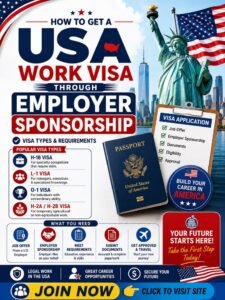
Finding a job in the United States that offers visa sponsorship can be challenging, especially if you are applying from outside the country. However, it is possible to find employers that sponsor qualified international workers for certain positions.
The key is to understand which visa categories may apply to your situation, identify employers that have a history of sponsoring workers, search for jobs using the right keywords, and make your application competitive.
Visa sponsorship does not mean that every international applicant will qualify. U.S. immigration rules are complex, and eligibility depends on factors such as your occupation, education, experience, nationality, and the specific visa category.
Here is how to approach your job search.
1. Understand What Visa Sponsorship Means
Visa sponsorship generally means that a U.S. employer is willing to take the required steps with U.S. immigration authorities to support an eligible foreign worker’s employment.
For some employment-based visas, the employer must file a petition or complete other required processes. In certain situations, the employer may also need to demonstrate that it meets specific labor or employment requirements.
It is important to understand that receiving a job offer does not automatically give you permission to work in the United States.
You need the appropriate immigration status or employment authorization before you can legally begin working.
2. Identify the Visa Category You May Qualify For
One of the first steps is determining which employment-based visa or immigration pathway could apply to you.
For example, the H-1B program can be relevant to certain specialty occupations that require specialized knowledge and typically a bachelor’s degree or equivalent qualification.
The L-1 visa can apply to certain employees transferring within a multinational company from an overseas office to a related U.S. office.
The O-1 category may apply to individuals who can demonstrate extraordinary ability or achievement in qualifying fields.
There are also employment-based immigrant visa categories for workers seeking permanent residence, including categories that can involve employer sponsorship.
The right option depends on your circumstances, so do not assume that every job with a company that sponsors workers will qualify for the same visa.
3. Search for Employers That Sponsor Foreign Workers
Instead of applying to every job you see, focus your search on companies that have a history of sponsoring international employees.
Large technology companies, consulting firms, financial institutions, healthcare organizations, universities, research institutions, engineering companies, and multinational corporations may sponsor workers for qualifying positions.
However, sponsorship policies can differ between departments and job openings.
A company that sponsored an employee in the past may not sponsor every position today.
4. Use the Right Job Search Keywords
When searching online, use specific phrases related to sponsorship.
Examples include:
- “visa sponsorship”
- “visa sponsorship available”
- “H-1B sponsorship”
- “will sponsor”
- “employment visa sponsorship”
- “international applicants”
- “sponsorship available”
- “OPT to H-1B sponsorship”
You can combine these terms with your profession.
For example, you could search for:
“software engineer visa sponsorship USA”
or
“registered nurse visa sponsorship USA.”
This can help narrow your search to positions where sponsorship may be more likely.
5. Check the Job Description Carefully
Do not assume that a company sponsors visas simply because it is a large American employer.
Read each job description carefully.
Some employers clearly state whether they will sponsor applicants who require employment authorization now or in the future.
Other listings may say that applicants must already have authorization to work in the United States and that the company will not sponsor immigration-related work authorization.
These statements are important.
If a job specifically says “no visa sponsorship,” you should generally avoid spending significant time applying unless you have a different legal basis for working in the United States.
6. Look for High-Demand Professional Skills
Your chances may improve if your profession requires skills that are difficult for employers to find locally.
Fields that may have opportunities for international professionals include technology, engineering, healthcare, scientific research, mathematics, specialized business functions, and certain skilled occupations.
However, demand does not guarantee sponsorship.
Employers still evaluate candidates based on qualifications, experience, business needs, and applicable immigration rules.
Having a specialized skill can make you more competitive, but it does not automatically qualify you for a visa.
7. Build a Strong Resume
If you need sponsorship, your resume needs to make a strong case for why an employer should consider you.
Focus on measurable accomplishments rather than simply listing job duties.
For example, instead of saying:
“Managed software projects.”
You could write:
“Managed five software projects and helped reduce average delivery time by 20%.”
Highlight skills that are directly relevant to the job.
Include your education, certifications, technical skills, professional experience, major projects, publications, awards, or other accomplishments when relevant.
Keep the resume clear and easy to read.
8. Apply Directly Through Company Career Websites
Company career websites are often a useful place to search for positions.
Look for the employer’s official careers page and search for your profession and relevant sponsorship terms.
Applying directly can help you understand the company’s requirements and avoid questionable third-party job advertisements.
You can also create job alerts when a company allows it.
This is useful because sponsorship-friendly positions can attract many applicants.
9. Use Professional Networking
Networking can be extremely valuable when searching for international employment opportunities.
Connect with professionals in your field through professional networking platforms, industry associations, conferences, university alumni networks, and professional communities.
Do not begin every conversation by immediately asking someone to sponsor you.
Instead, build professional relationships and learn about companies, teams, career opportunities, and hiring practices.
A referral from someone who knows your work can sometimes help your application receive more attention.
10. Consider Multinational Companies
Multinational companies can be particularly worth researching because they may have offices in several countries.
Working for a multinational company outside the United States can sometimes create future opportunities to transfer to a related U.S. office, depending on the company’s structure and your eligibility for the appropriate immigration category.
This does not guarantee a U.S. transfer or visa.
However, it can be a useful long-term career strategy for some professionals.
11. Consider Universities and Research Organizations
Universities and research institutions hire international professionals in areas such as science, engineering, medicine, education, technology, and research.
If you have an advanced degree, research experience, publications, or specialized expertise, these organizations may be worth exploring.
Certain immigration categories also have special rules for some nonprofit research or higher-education employers.
Because immigration rules can be complicated, applicants should verify the current requirements for their specific situation.
12. Be Careful With Job Scams
Visa sponsorship searches attract scammers because people are often willing to pay money for a U.S. job opportunity.
Be extremely cautious if someone promises a guaranteed visa or guaranteed employment in exchange for a large upfront payment.
A legitimate employer should provide professional employment information and should not pressure you into paying suspicious fees simply to receive a job offer.
Be especially careful with fake recruiters who use company names, logos, or job descriptions copied from legitimate employers.
Verify the position through the company’s official career website and communicate through legitimate business channels.
13. Understand That Sponsorship Is Not Guaranteed
One of the biggest mistakes international applicants make is assuming that a job offer automatically means visa sponsorship.
Employers have their own policies, and immigration categories have their own eligibility requirements.
Even if a company sponsors foreign workers, it may not sponsor every position.
For some visa programs, there may also be annual limits or selection processes.
Therefore, you should treat sponsorship as one part of your job search rather than the only factor.
14. Improve Your Qualifications Before Applying
If you are having difficulty finding sponsorship, consider strengthening your professional profile.
Depending on your career, this could mean earning a degree, gaining additional professional experience, obtaining certifications, learning a high-demand technology, improving your English communication skills, or building a portfolio.
For technical professionals, practical projects can demonstrate ability.
For researchers, publications and research achievements may be valuable.
For healthcare professionals, the necessary U.S. licensing and credential requirements can be especially important.
The best improvement depends on your target occupation.
How to Find Visa-Sponsoring Jobs Step by Step
A simple strategy is to follow these steps:
- Choose your target occupation.
- Research which U.S. employment visa categories may apply.
- Identify companies that hire people with your skills.
- Research their sponsorship history and current policies.
- Search their official career websites.
- Use keywords such as “visa sponsorship” and “will sponsor.”
- Tailor your resume to each position.
- Apply only when your qualifications match the requirements.
- Network with professionals in your industry.
- Verify employers and avoid sponsorship scams.
- Prepare for interviews and immigration-related questions.
- Consult a qualified immigration attorney when you need legal advice