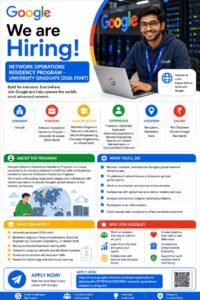
Getting a job at Google is a career goal for many people. Google is known for its technology, global workforce, and wide range of career opportunities. However, getting hired can be competitive because many qualified applicants apply for the same positions.
If you want to get a job at Google in 2026, the best approach is to understand what the company is looking for, find positions that match your qualifications, prepare a strong application, and get ready for the interview process.
You do not necessarily need to be an experienced software engineer to work at Google. The company hires people in areas such as engineering, sales, marketing, finance, design, human resources, operations, research, cloud technology, and many other fields.
Here is a step-by-step guide to help you pursue a Google job in 2026.
1. Start With Google Careers
The first step is to search for jobs through the official Google Careers website.
Google regularly posts new positions, and available jobs can change as the company’s hiring needs change. You can search by job title, location, organization, skills, and experience level.
If you are looking for an entry-level opportunity, search for terms such as:
- Early Career
- University Graduate
- Campus
- Entry Level
- Intern
- Student
If you already have professional experience, you can search for positions that match your current career level.
Do not rely only on job advertisements posted on social media or third-party websites. Check the official Google Careers listing before applying.
2. Choose the Right Google Job
One of the biggest mistakes applicants make is applying for a position simply because they want to work at Google.
Instead, focus on jobs where your qualifications match the requirements.
For example, if you have a computer science background and programming experience, software engineering may be a natural fit.
If your background is in marketing, look for marketing, communications, or related positions.
If you have experience in finance, search for financial or business-related roles.
Read the entire job description before applying. Pay attention to the minimum qualifications, preferred qualifications, responsibilities, location, and other requirements.
A strong application starts with choosing the right position.
3. Understand the Qualifications
Google does not have one set of qualifications that applies to every employee.
The requirements depend on the job.
Some positions may require a bachelor’s degree or equivalent practical experience. Others may require specific professional experience, technical knowledge, certifications, or specialized education.
For example, an engineering position could require programming experience, while a finance position may require financial knowledge and relevant professional experience.
If you are a recent graduate, look for early-career and university-level opportunities.
If you do not have a traditional degree, look for positions that accept equivalent practical experience where appropriate.
Always use the individual job description as your guide.
4. Build the Skills Google Needs
If you want to work at Google in 2026, developing relevant skills should be one of your priorities.
The skills you need depend on your career path.
Technical candidates may need skills in areas such as:
- Programming
- Data structures and algorithms
- Artificial intelligence
- Machine learning
- Cloud computing
- Cybersecurity
- Data analysis
- Software development
- Databases
Non-technical candidates may need skills in:
- Marketing
- Sales
- Communication
- Finance
- Project management
- Business strategy
- Research
- Design
- Operations
You do not need to learn everything.
Instead, identify the skills repeatedly requested in the Google jobs that interest you and focus your learning on those areas.
5. Gain Practical Experience
You do not always need years of professional experience to apply for Google jobs.
However, practical experience can make your application stronger.
If you are a student, look for internships. If you are a recent graduate, consider freelance work, volunteer projects, research, personal projects, or entry-level positions that allow you to develop relevant skills.
For example, an aspiring software engineer could create several applications and publish them in a portfolio.
Someone interested in marketing could develop a marketing campaign for a small business or personal project.
Someone interested in data analysis could analyze public datasets and present the findings.
Practical experience gives you specific examples to discuss on your resume and during interviews.
6. Create a Strong Resume
Your resume is an important part of your application.
Keep it clear, concise, and focused on the position you want.
Include your education, work experience, projects, skills, internships, certifications, and relevant achievements.
Whenever possible, focus on results.
Instead of simply saying:
“Worked on a website.”
You could explain what you built, which technologies you used, and what the project accomplished.
If you are a recent graduate without full-time experience, place more emphasis on projects, internships, coursework, research, and other relevant accomplishments.
Most importantly, do not include skills you cannot demonstrate.
7. Tailor Your Application
A generic application may not effectively communicate why you are a good match for a specific position.
Before submitting your application, compare your resume with the job description.
Identify the important skills and qualifications mentioned in the posting and make sure your relevant experience is clearly visible.
This does not mean copying the job description into your resume.
Instead, use accurate descriptions of your own experience that naturally demonstrate how your background matches the position.
For example, if a job emphasizes data analysis, highlight projects or work where you analyzed data and produced useful results.
8. Apply Through the Official Website
Once you find a suitable position, follow the application instructions provided in the official Google Careers listing.
You will generally need a Google Account and a Careers Profile to apply.
Provide accurate information and review your application carefully before submitting it.
Check your contact information, education, employment history, resume, and application responses.
Do not exaggerate your qualifications.
If you do not meet the requirements for one position, consider finding another position that better matches your background.
9. Prepare for Google’s Interview Process
Getting an application submitted is only the beginning.
If your application progresses, you may be contacted for interviews or assessments depending on the position.
The interview process varies by job.
Technical candidates may need to complete coding or technical interviews.
Business and non-technical candidates may be asked questions about their professional experience, analytical thinking, communication, leadership, teamwork, and problem-solving abilities.
Before your interview, carefully review the job description.
Think about examples from your education, employment, internships, and projects that demonstrate your abilities.
Practice explaining how you handled challenges and what results you achieved.
10. Prepare for Technical Interviews
If you are applying for an engineering or other technical position, technical preparation can be especially important.
Depending on the role, you may need to demonstrate knowledge of programming, algorithms, data structures, system design, databases, or other technical subjects.
Start preparing early rather than waiting until you receive an interview invitation.
Practice solving problems without immediately looking at the solution.
More importantly, learn how to explain your thinking.
An interviewer may be interested not only in whether you reach the correct answer but also in how you approach the problem.
11. Prepare for Behavioral Interviews
Technical skills are not the only thing that matters.
You should also be prepared to discuss situations where you demonstrated teamwork, leadership, communication, decision-making, and problem-solving.
Prepare several real examples from your experience.
For instance, think about a time when you:
- Solved a difficult problem
- Worked with a difficult teammate
- Led a project
- Made a mistake and learned from it
- Had to meet a tight deadline
- Improved an existing process
- Dealt with disagreement
- Took responsibility for an important task
Use real experiences rather than memorized stories.
12. Consider Google’s Early-Career Opportunities
If you are graduating in 2026 or have limited professional experience, do not focus only on jobs requiring several years of experience.
Search for early-career opportunities.
Google has positions specifically aimed at people earlier in their professional careers, as well as internships and student opportunities.
A recent graduate may qualify based on education, projects, internships, and relevant skills even without a long employment history.
The exact requirements vary by job, so always check the individual listing.
13. Understand U.S. Work Authorization
If you want to work at Google in the United States, pay attention to work authorization requirements.
Being qualified for a position does not automatically mean you are legally eligible to work in the United States.
If you are applying from another country, carefully read the job description for information about location, work authorization, relocation, and sponsorship.
Do not assume that every U.S. Google position offers visa sponsorship.
If you are already authorized to work in the United States, make sure you understand any requirements that apply to your situation.
14. Keep Applying Strategically
Do not become discouraged if your first application does not result in an interview.
Google receives applications from many qualified candidates.
Instead of applying randomly to every job, look for positions that closely match your qualifications.
You can also continue developing your skills while searching.
If you are rejected for a position, use the experience as motivation to improve your resume, skills, projects, and interview preparation.
A career at Google does not have to happen immediately after graduation.
You can gain experience elsewhere and apply again when you are a stronger candidate.
15. Avoid Google Job Scams
Be careful when searching for Google jobs online.
Use the official Google Careers website to verify job listings.
Be suspicious of anyone who promises you a guaranteed Google job in exchange for money.
A legitimate job application should not require you to pay someone to guarantee employment.
Never give passwords, unnecessary financial information, or other sensitive information to someone simply because they claim to represent Google.
.